

Saturday, May 28, 2011

Friday, May 27, 2011
REAL FORUM Podcast Against Censorship
<object width="400" height="300"><param name="allowfullscreen" value="true" /><param name="allowscriptaccess" value="always" /><param name="movie" value="http://vimeo.com/moogaloop.swf?clip_id=24341808&server=vimeo.com&show_title=0&show_byline=0&show_portrait=0&color=00adef&fullscreen=1&autoplay=0&loop=0" /><embed src="http://vimeo.com/moogaloop.swf?clip_id=24341808&server=vimeo.com&show_title=0&show_byline=0&show_portrait=0&color=00adef&fullscreen=1&autoplay=0&loop=0" type="application/x-shockwave-flash" allowfullscreen="true" allowscriptaccess="always" width="400" height="300"></embed></object><p><a href="http://vimeo.com/24341808">Untitled</a> from <a href="http://vimeo.com/user7203262">Gerald Mcklintoq</a> on <a href="http://vimeo.com">Vimeo</a>.</p>
if the embedded video does not work.
http://vimeo.com/24341808
if the embedded video does not work.
http://vimeo.com/24341808
FORUM Podcast Against Censorship
<iframe src="http://player.vimeo.com/video/24341808?title=0&byline=0&portrait=0" width="400" height="300" frameborder="0"></iframe><p><a href="http://vimeo.com/24341808">Untitled</a> from <a href="http://vimeo.com/user7203262">Gerald Mcklintoq</a> on <a href="http://vimeo.com">Vimeo</a>.</p>
We hope you Enjoy it,
Sincerely,
Epictetus and Banquo
We hope you Enjoy it,
Sincerely,
Epictetus and Banquo
Friday, May 6, 2011
Should marijuana use be legalized in the United States?
Answer this question and other topical political questions with this poll.
Sunday, April 24, 2011
Oil: Our Nations Tainted Blood
Every day the United States consumes 19.6 million barrels of oil 60% of which is from foreign countries torn by war and poverty. This precious resource of oil, along with coal and natural gas accounts for 85% of the U.S. total energy. Can our nation maintain our energy policy the way things are going? Importing millions of barrels of oil from tyrants in the middle east and having the prices increased on American citizens as a result of all the conflicts that go on there, is no way for a nation to sustain itself.
The Middle Eastern region has been plunged into even greater war and chaos since the rise of the Egyptian people against their ,one time leader Hosni Mubbarack. Since then riots and revolutions have broken out in Bahrain, Libya, Syria, Algeria, Iraq and other countries in the region resulting in the skyrocketing of oil prices to well over $100 per barrel. Bahrain especially should be considered by the United States as a high value conflict because it is right on the border of the largest oil exporter in the world ,Saudi Arabia, who has sent ground troops to stop the rebellion against ruling family of Bahrain. Because of the great U.S. dependency on foreign oil especially from Saudi Arabia the U.S. can do nothing to help the people of Bahrain stand up against the Saudi and their own government Saudi Arabia is swamped in a vast multitude of human rights violations and uses the Mahabith , the Saudi Arabia secret police, to enforce sharia law and execute anyone who might be a threat to the state. In essence the U.S. is completely tied to the whims of the oil exporting countries in the Middle East and is forced to work with them in spite of the fact that they are vehemently against the values of human freedom that America is supposed to stand for.
The American dependency on foreign oil is not only compromising our values on international policy and subjecting the American people to higher oil prices but is economically damaging areas of the United States that could easily make money off of oil drilling in their region. Currently a moratorium is on oil drilling in the Gulf of Mexico where massive oil reserves are being kept just off the coast of the United States. This moratorium was put back in place after being repealed for only a few months as a result of the BP oil spill and the economic and environmental catastrophe that it caused.
The BP oil spill could have been prevented very easily were there just a bit more oversight on the oil company's safety procedures and far less inefficiency and bureaucracy in government procedures to clean up the spill in its early stages. The problem is not off shore drilling itself but how it is handled. If the U.S. government paid greater attention to the issues with offshore drilling as opposed to simply trying to dispose of it all together, many rural and poor areas of the United States could bring in considerable revenue and become economically stable and U.S. energy needs would be completely met.
This blog post may be a very shallow scratch on the surface of American Energy issues but it serves as an introduction to it and an expression of my opinion of how we could improve the state of our union.

Why not bend over a little more Obama. America should not be bowing to the monarch of a state that has a human rights record written in the blood of women whose ankles were showing in public.
The Middle Eastern region has been plunged into even greater war and chaos since the rise of the Egyptian people against their ,one time leader Hosni Mubbarack. Since then riots and revolutions have broken out in Bahrain, Libya, Syria, Algeria, Iraq and other countries in the region resulting in the skyrocketing of oil prices to well over $100 per barrel. Bahrain especially should be considered by the United States as a high value conflict because it is right on the border of the largest oil exporter in the world ,Saudi Arabia, who has sent ground troops to stop the rebellion against ruling family of Bahrain. Because of the great U.S. dependency on foreign oil especially from Saudi Arabia the U.S. can do nothing to help the people of Bahrain stand up against the Saudi and their own government Saudi Arabia is swamped in a vast multitude of human rights violations and uses the Mahabith , the Saudi Arabia secret police, to enforce sharia law and execute anyone who might be a threat to the state. In essence the U.S. is completely tied to the whims of the oil exporting countries in the Middle East and is forced to work with them in spite of the fact that they are vehemently against the values of human freedom that America is supposed to stand for.
The American dependency on foreign oil is not only compromising our values on international policy and subjecting the American people to higher oil prices but is economically damaging areas of the United States that could easily make money off of oil drilling in their region. Currently a moratorium is on oil drilling in the Gulf of Mexico where massive oil reserves are being kept just off the coast of the United States. This moratorium was put back in place after being repealed for only a few months as a result of the BP oil spill and the economic and environmental catastrophe that it caused.
The BP oil spill could have been prevented very easily were there just a bit more oversight on the oil company's safety procedures and far less inefficiency and bureaucracy in government procedures to clean up the spill in its early stages. The problem is not off shore drilling itself but how it is handled. If the U.S. government paid greater attention to the issues with offshore drilling as opposed to simply trying to dispose of it all together, many rural and poor areas of the United States could bring in considerable revenue and become economically stable and U.S. energy needs would be completely met.
This blog post may be a very shallow scratch on the surface of American Energy issues but it serves as an introduction to it and an expression of my opinion of how we could improve the state of our union.
Why not bend over a little more Obama. America should not be bowing to the monarch of a state that has a human rights record written in the blood of women whose ankles were showing in public.
Tuesday, April 19, 2011
Banquo Sells Out: Some Good Movies You Maybe Have Already Seen, But If Not, You Should Go See Them Right Now
This week, I thought I'd abandon my usual political musings in favor of something a little more, well, accessible. I will be listing a few fantastic movies (in no particular order) that you may have opinions about that are contrary to mine. If you disagree with anything I say, please post a response. I'm a very reasonable person.
Fantastic Movie #1: The Searchers
The Searchers is, beyond a doubt, the greatest western movie of all time. John Wayne delivers an astounding performance as Ethan, a civil war veteran obsessed with the task of finding his niece, Debbie, who has been kidnapped by Comanche Indians. Part of what makes this movie so great is its backdrop: director John Ford wisely to shoot this movie, set on the plains of North Texas, in Utah's beautiful Monument Valley. As a lover of westerns and a fan of John Wayne, I would recommend this movie to anyone with similar inclinations.
Fantastic Movie #2: The Departed
"I'm tired from f*****g your wife." says Lieutanant Dingam, played by the unflinchingly vicious Mark Wahlberg. A character played by Alec Baldwin is not amused. "How's your mother?" he retorts.
"Good." Dingam says. "She's tired from f*****g my father."
Need I say more?
I might as well. The Departed is a Scorcese-directed remake of the Asian classic Internal Affairs. Leo DiCaprio plays a detective planted in side a mob led by Frank Costello, who is portrayed chillingly by Jack Nicholson. Meanwhile, Costello's agent Collin Sulivan (Matt Damon) serves as his mole in the Massachusets State Police. Both men discover the existence of one another, and set off after each other with deadly results. Alec Baldwin and Martin Sheen have fantastic minor roles, but Mark Wahlberg (in a Oscar-nominated role) really steals the show as Dingam, the foul-mouthed detective.
To sum it up: it's a f*****g good movie.
Fantastic Movie #3: Saving Private Ryan
Who here likes watching violent movies? Movies with blood, gore, human innards: the works. Meanwhile, who enjoys movies with a sensitive message? A message of peace, love: the usual crap. Believe it or not, Saving Private Ryan, the WWII Spielberg directed film whose portrayal of Omaha Beach is perhaps the bloodiest 10 minutes in movie history, contains more sensitivity than three romantic comedies piled up on each other.
The movie begins with Captain Miller (Tom Hanks) and his squad of rangers (including Ed Burns, Tom Sizemore, and Vin Diesel) arriving under great duress at Omaha Beach. Almost immediatly after the beach is secured, the squad is ordered to march behind enemy lines to kidnap Private Ryan (Matt Damon), a 101st Airbone serviceman whose three brothers have just died. The squads emotional journey includes sniper fire, Germans hiding in a bunker, and a whole lot of death. I won't spoil the ending, but you should probably keep a box of tissues in arms reach, just in case.
A disclaimer: I am not a film snob, nor do I pretend to be one. If you disagree with my movie choices and have something to say about it, then fine. Please post a comment. Additionally, if you think I've overlooked any movies, please list some of your own below.
-Banquo
Fantastic Movie #1: The Searchers
The Searchers is, beyond a doubt, the greatest western movie of all time. John Wayne delivers an astounding performance as Ethan, a civil war veteran obsessed with the task of finding his niece, Debbie, who has been kidnapped by Comanche Indians. Part of what makes this movie so great is its backdrop: director John Ford wisely to shoot this movie, set on the plains of North Texas, in Utah's beautiful Monument Valley. As a lover of westerns and a fan of John Wayne, I would recommend this movie to anyone with similar inclinations.
 |
| The movie's poster |
"I'm tired from f*****g your wife." says Lieutanant Dingam, played by the unflinchingly vicious Mark Wahlberg. A character played by Alec Baldwin is not amused. "How's your mother?" he retorts.
"Good." Dingam says. "She's tired from f*****g my father."
Need I say more?
I might as well. The Departed is a Scorcese-directed remake of the Asian classic Internal Affairs. Leo DiCaprio plays a detective planted in side a mob led by Frank Costello, who is portrayed chillingly by Jack Nicholson. Meanwhile, Costello's agent Collin Sulivan (Matt Damon) serves as his mole in the Massachusets State Police. Both men discover the existence of one another, and set off after each other with deadly results. Alec Baldwin and Martin Sheen have fantastic minor roles, but Mark Wahlberg (in a Oscar-nominated role) really steals the show as Dingam, the foul-mouthed detective.
To sum it up: it's a f*****g good movie.
 |
| Mark "f*****g" Wahlberg |
Who here likes watching violent movies? Movies with blood, gore, human innards: the works. Meanwhile, who enjoys movies with a sensitive message? A message of peace, love: the usual crap. Believe it or not, Saving Private Ryan, the WWII Spielberg directed film whose portrayal of Omaha Beach is perhaps the bloodiest 10 minutes in movie history, contains more sensitivity than three romantic comedies piled up on each other.
The movie begins with Captain Miller (Tom Hanks) and his squad of rangers (including Ed Burns, Tom Sizemore, and Vin Diesel) arriving under great duress at Omaha Beach. Almost immediatly after the beach is secured, the squad is ordered to march behind enemy lines to kidnap Private Ryan (Matt Damon), a 101st Airbone serviceman whose three brothers have just died. The squads emotional journey includes sniper fire, Germans hiding in a bunker, and a whole lot of death. I won't spoil the ending, but you should probably keep a box of tissues in arms reach, just in case.
A disclaimer: I am not a film snob, nor do I pretend to be one. If you disagree with my movie choices and have something to say about it, then fine. Please post a comment. Additionally, if you think I've overlooked any movies, please list some of your own below.
 |
| Be warned, Nazis: Tom Hanks is coming to kill you. |
Monday, April 11, 2011
Eduardo Leads
1 am at the end of Congress Avenue and lights are still streaming out of the windows of the Capitol building. Politicians are walking out on to the capital grounds and are walking towards their cars hoping to make it home to get a few hours sleep before tomorrow’s day of work.
“ Well, there isn’t really a typical day. It isn’t like an eight to five job…” For Donna Howard ,Democratic State Representative for Travis County, it has been the beginning of a difficult two years in office.
Press conferences, baby kissing, shaking hands and adoring constituents. “My point being because we run for office every other November you are going to be on the ballot you are having to raise funds for a large part of that two year period because you are almost always campaigning.”
REAL Felix leads
Comparison (ish thing): Every human being is familiar with the words "I don't want to talk about it", when a problem is brought to a parent. However, this not expected from the government. In Wisconsin, however, this is exactly the answer that thousands of people could be getting.
Twist: We do not live in a dictatorship in America. What the government says does not always go, the public has a right to reason with it. But in wisconsin, bargaining has become more of a dictatorship style affair.
(did not finish a third one)
Twist: We do not live in a dictatorship in America. What the government says does not always go, the public has a right to reason with it. But in wisconsin, bargaining has become more of a dictatorship style affair.
(did not finish a third one)
Sunday, April 10, 2011
Banquo's Leads
Descriptive:The internet has changed things. Jobs once hard have become easy, and jobs once easy have become hard. While people rightfully point to successes like social networking and Youtube, there is one industry that has been damaged by internet availability more than any other: Journalism. Stories people once paid $7 for at a newsstand are now available at the click of a button on CNN.com or Drudge Report. News organizations now revert to the standards of tabloid rags, neglecting serious stories and focusing on non-issues (Charlie Sheen). Can the industry be saved? Mark Miller is optimistic.
Descriptive:The outlook is bleak for journalism. In financially uncertain times, frugal readers opt to use Newsweek.com instead of ordering a subscription to the magazine. Revenues are decreasing, and magazines have felt the crunch. News organizations frequently resort to attention grabbing headlines (“Target: Iran” and “American Assassins”) that provide little actual entertainment or information. The industry seems to waiting for its knight in shining armor. Online news, according to Mark Miller, could be this savior.
Descriptive: Print news has seen its ups and downs. News has started wars (Spanish American War), removed presidents (Watergate scandal), revealed atrocities (the Pentagon Papers), and has hounded celebrities to death (Michael Jackson). While America’s relationship with its press has always been unpredictable, it is clear now that conventional print journalism is in decline. However, Mark Miller sees a way out of this quagmire: nonprofit online journalism is the way to go.
--Banquo
Friday, April 8, 2011
Opinion leads (felix)
Imagine this:
Imagine this, one day you are happily being in a union and collectively bargaining away, when suddenly there is an email that says that "no you can't". In wisconsin, this email actually happened, and is a horrible thing for people to read because it is bad.
Narrative
Every day, some people are in unions. They are having lots of fun with the abilities of them. But sometimes, the government says NO.
Twist
Children are children. but when they get older, they want to join unions, and if wisconsin is going to stay like it is right now, it's pointless to want to BECAUSE THEY CAN'T in wisconsin.
Imagine this, one day you are happily being in a union and collectively bargaining away, when suddenly there is an email that says that "no you can't". In wisconsin, this email actually happened, and is a horrible thing for people to read because it is bad.
Narrative
Every day, some people are in unions. They are having lots of fun with the abilities of them. But sometimes, the government says NO.
Twist
Children are children. but when they get older, they want to join unions, and if wisconsin is going to stay like it is right now, it's pointless to want to BECAUSE THEY CAN'T in wisconsin.
Thursday, April 7, 2011
Foreign Language Course: Politician 101
For my feature story I interviewed state representative Donna Howard. There is no average day while the legislature is in session and you are always campaigning were the two biggest points of the interview.
Ms.Howard mentioned how they would be working for a few hours debating over the issues and would then have to go to meetings with constituents and political organizations looking to give their opinions. For five months out of every two years the lives of the representatives become disorganized hells and provide great interest for the average citizens.
Campaigning for Representative Howard is supposedly a full term job. Through out her two years or term in office she has to be prepairing for her next campaign as the time in office for a state representative is so short.
I apologize for writing this useless crap as opposed to my usual articles but this was an assignment for ezine which I have to do for my grade.So yeah.
Sincerely,
Indigenous to Epictetus
Ms.Howard mentioned how they would be working for a few hours debating over the issues and would then have to go to meetings with constituents and political organizations looking to give their opinions. For five months out of every two years the lives of the representatives become disorganized hells and provide great interest for the average citizens.
Campaigning for Representative Howard is supposedly a full term job. Through out her two years or term in office she has to be prepairing for her next campaign as the time in office for a state representative is so short.
I apologize for writing this useless crap as opposed to my usual articles but this was an assignment for ezine which I have to do for my grade.So yeah.
Sincerely,
Indigenous to Epictetus
Banquo's Thoughts: An Interview, Plus a Little Bit of Swearing
I swear I'd never take orders for a blog post. Besides toning down my original message (see my first blog post, which contained profanity) on the orders of Ms. Young, all of my blog posts have been my thoughts, original and unadulterated.
Now, I have to take orders: the powers that be want everyone to write a blog about their feature pieces. I don't want to do it. But I have to.
Sorry everybody, but I think a little bit of angry swearing is in order.
"%$#! *&^*^% &$@#!!"
Now, let me take you, begrudgingly, into the world of Mark Miller, my interviewee. Mark is the editor of the Texas Tribune, a nonpartisan, non-for-profit news organization that makes information valuable to the public available on its free website. I spoke to him about his career in journalism (he has worked at Newsweek, writing about Bill Clinton, OJ Simpson, and 9/11) and the state of public affairs in Texas. We also spoke about the future of journalism and how news organizations have struggled to succeed in a digital age.
I conducted the interview by Email because Mark was on a business trip. I got a lot of good information out of him that will factor well into my feature piece.
Congratulations, powers that be- you just made me take orders. Grrrrrrrrrr.
Sincerely,
An irked Banquo
Now, I have to take orders: the powers that be want everyone to write a blog about their feature pieces. I don't want to do it. But I have to.
Sorry everybody, but I think a little bit of angry swearing is in order.
"%$#! *&^*^% &$@#!!"
Now, let me take you, begrudgingly, into the world of Mark Miller, my interviewee. Mark is the editor of the Texas Tribune, a nonpartisan, non-for-profit news organization that makes information valuable to the public available on its free website. I spoke to him about his career in journalism (he has worked at Newsweek, writing about Bill Clinton, OJ Simpson, and 9/11) and the state of public affairs in Texas. We also spoke about the future of journalism and how news organizations have struggled to succeed in a digital age.
I conducted the interview by Email because Mark was on a business trip. I got a lot of good information out of him that will factor well into my feature piece.
Congratulations, powers that be- you just made me take orders. Grrrrrrrrrr.
Sincerely,
An irked Banquo
 |
| An accurate expression of how angry I am |
Friday, April 1, 2011
Screw the Mafia: Cartels, The New Threat to the United States
The Gambino, Colombo, Banano, Genovese and Lucchese names that once struck fear into the hearts of many Americans who were told that the Mafia did not even exist, and all the disappearances of people of the street a minor figment of the imagination. For nearly four decades the United States has been able to breath easily knowing that there is no all powerful criminal organization that can snatch them out of their beds at night. But in recent years there has been considerably more to worry about from criminal organizations. Since 2006 Mexico has been engaged in an ongoing full scale war against the Mexican drug cartels, a war which has been spilling over into America and terrorizing along with claiming the lives of innocent people living in the Mexican border region.
There are many people who have seen the movies The Godfather, Good Fellas and so on and some of those movies were relatively accurate in their depictions of the mafia. Consider now those same movies but the handguns being replaced fully automatic weapons, armored vehicles and other military grade weaponry. These are just thugs gathering in the cities and beating shop owners for protection money; the Mexican drug cartels have far more resources and training than that. The leader of the Zetas, Heriberto Lazcano known as "El Lazca" is an ex special forces operator for Mexico and now leads Los Zetas one of the two most power drug cartels.
These Cartel's have now displaced the Colombian cartel's in the market for cocaine and heroin trafficked to the United States and have many of the Mexican politicians in their pockets. Military force has been used to combat these organizations since 2006 and only a few of the leaders have been captured and still 34,612 people have been killed in the drug wars according to BBC news.
Most of America's cocaine, marijuana, heroin and methamphetemines come from Mexico and are trafficked in men with military training, military grade weapons and who know the territory of the south western United States and northern Mexcio better than anyone. These men are extrememly dangerous and need to be dealt with as opposed to just ignored by the United States government lest more lives ,many of them American, be lost.
There are many people who have seen the movies The Godfather, Good Fellas and so on and some of those movies were relatively accurate in their depictions of the mafia. Consider now those same movies but the handguns being replaced fully automatic weapons, armored vehicles and other military grade weaponry. These are just thugs gathering in the cities and beating shop owners for protection money; the Mexican drug cartels have far more resources and training than that. The leader of the Zetas, Heriberto Lazcano known as "El Lazca" is an ex special forces operator for Mexico and now leads Los Zetas one of the two most power drug cartels.
These Cartel's have now displaced the Colombian cartel's in the market for cocaine and heroin trafficked to the United States and have many of the Mexican politicians in their pockets. Military force has been used to combat these organizations since 2006 and only a few of the leaders have been captured and still 34,612 people have been killed in the drug wars according to BBC news.
Most of America's cocaine, marijuana, heroin and methamphetemines come from Mexico and are trafficked in men with military training, military grade weapons and who know the territory of the south western United States and northern Mexcio better than anyone. These men are extrememly dangerous and need to be dealt with as opposed to just ignored by the United States government lest more lives ,many of them American, be lost.
Thursday, March 31, 2011
How to drive:
To drive in england, there are things you must be able to do. First, you must pay for an opportunity to take the drivers test at 31 pounds per attempt. Second, you must be answer eighty six percent of the questions on a multiple choice quiz corectly. Then, you must drive with someone who will test your ability to maneuver your car. There are people who have failed this step up to 48 times. There are many people who have failed the multiple choice test as well, but generally not as badly. But there are some that have failed quite awfully. In fact, the record has recently been set by a 26 year old woman who's identity has never been released. This record was 90 times. That makes £2790. After the first 10 times, even if you were awful at memorizing systems, you might even be able to recall the questions in your head. But somehow, this woman seems to have acquired repeating amnesia or something. If a person can forget things this many times in a row, they would probably forget that their car could not travel through cars or other solid objects. This would be inconvenient if you were a solid object near her. I believe that someone who has failed this test more than 20 times should not be allowed to drive. Ever. The people who failed the actual driving portion would be okay, it might just be a motor disorder of some sort, or they just have awful hand eye coordination. But if they get repeating amnesia, they should not be allowed to be on the road.
-Felix!
-Felix!
Some things I missed...
My last post on the likely 2012 Republican candidates was incomplete. First of all, my post came before the revelation that Tea Party stalwart Michele Bachmann was considering running for president. Though I don't think she will preform very well at the polls, it is my duty to evaluate her along with the rest of the candidates. So, here we go.
Michele Bachmann
Pros: Feisty, well-known legislator from America's heartland. Tea Party members love her.
Cons: All hail Palin 2.0- more sound bites, more gaffes, and more "Obama is a socalist" mumbo jumbo.
Chances of Winning Primary: She has a bit of a shot in Iowa. However, I would put her chances at less than one percent.
Also missing from my previous post is former Pennsylvania Senator Rick Santorum.
Rick Santorum
Pros: Popular with right wingers.
Cons: Low name recognition.
Chances of Winning Primary: He's a dark horse candidate, with a lot of appeal but very little capital.
-Banquo
Michele Bachmann
Pros: Feisty, well-known legislator from America's heartland. Tea Party members love her.
Cons: All hail Palin 2.0- more sound bites, more gaffes, and more "Obama is a socalist" mumbo jumbo.
Chances of Winning Primary: She has a bit of a shot in Iowa. However, I would put her chances at less than one percent.
Also missing from my previous post is former Pennsylvania Senator Rick Santorum.
Rick Santorum
Pros: Popular with right wingers.
Cons: Low name recognition.
Chances of Winning Primary: He's a dark horse candidate, with a lot of appeal but very little capital.
 |
| Santorum |
Thursday, March 24, 2011
The Shifting Sands: A History of American Policy in The Middle East
The United States has had a significant presence in the middle east since the early 20th century with the event of the first world war for both economic and political purposes. The hot bed of activity and conflict that was created by colonization, constant war and the remaining influence of ancient empires is now seething with revolution and the flood of new ideas. Since those very early days of the U.S. presence and influence in the middle east countries like Egypt, Libya and Tunisia are starting to desire for freedom. Libya is waging an all out war on Ghadafi. Tunisia has little more than two months until its first democratic election. Egypt has thrown off the dictatorial Mubarak. There have been radical changes in that region over the past century and it leaves us wondering what is going to happen next.
In 1919 the League of Nations was formed at the urging of then, American President Woodrow Wilson in the wake of the first world war. Soon after its formation the League dissected the lands of the fallen Ottoman empire, who was defeated as one of the Axis powers in world war 1, into new colonial territories for the Western powers on the winning side of the war. This partition of the fallen Ottoman empire lead to the creation of States like Palestine, Jordan, Syria and Lebanon and set the stage for the events and regimes that we see in our world today.
Moving forward to the advent of the Cold War after the political map of the Middle East became much more similar to the one that we see in modern times the United States took many different military actions to influence the newly created states of the region. In 1953 the newly created Central Intelligence Agency launched the first of many operations in the middle east. This action was titled operation ajax and was meant to deter the spread of Communism to Iran and aid the Anglo-Iranian oil company in maintaining a high profit margin. The then newly elected and first ever democratic prime minister of Iran, Mohammad Mossadegh, wanted to nationalize the oil industry of Iran to stop foreign exploitation of Persian resources. This worried the Anglo Iranian oil company who then lobbied with both the British and American governments to stop that from happening. In response the CIA and British intelligence staged a coup that took months of preparation and propaganda production to succeed. Finally, after the coup, the CIA installed the once exiled Shah of Iran who then proceeded to lead a campaign of autocracy and terror against his own people until the 1979 Islamic revolution.
A decade later in Iraq the CIA planned but failed to eliminate the leader of Iraq general Abd al-Karim Qasim who five years earlier had over thrown the pro western monarch of Iraq. Luckily for the CIA the general was killed soon after the failed coup by a firing squad of the opposing Baath party. The United States then befriended the new regime of Iraq hoping to gain an anti soviet ally. The new Baath party leader of Iraq, Salam Arif died in 1966 when his brother a non Baath party member succeeded him. This new leader of Iraq was considering making oil pipeline deals with both the French and Soviet governments until the CIA gave support to the Baath party to stage a coup against the current regime, on the condition that the Baath party would give the oil in the northern part of the country to United States. This coup brought Hassan al-Bakr to power with the future Iraqi leader Sadam Hussein as a prominent lieutenant.
By the time the Cold War finished the United States had staged several other coups against Middle Eastern regimes that were unfavorable to the United States and installed pro western regimes who often turned out to be dictators. So where does this leave the United States? In the spur of the moment fueled by fear of falling behind in the Cold War the United States destroyed the bright hopes of many nations and in some cases started the wheels in motion for genocide. Because of U.S. interference Iran did not become a democracy, Iraq had Saddam Hussein come to power and many other countries were left bloodied and weaker than ever. These nations now left unstable and weak are unable to provide for themselves and many of them that are not under the rule of dictators live in lawless squalor and harbor the terror cells that the U.S. wants to be destroyed. Most of the ones that are controlled by dictators are now erupting in chaos and revolution with angry rebels firing off guns in the streets. Even worse, those nations still held in the iron grip of tyrants are some of the United States most valuable assets. Saudi Arabia, the oil baron of the world imposes radical Islam on its own people and has secret police, known as the Mabahith, patrol the streets and search for anyone who might think of opposing the regime. Before the Egyptian regime was over thrown and the Libyan regime jeopardized the United States rendition many of its covert prisoners over to these countries where they would be interrogated by means outlawed by the Geneva Conventions.
The United States has been playing a very risky game working with these nations in the middle east for the past century and attempting to manipulate every aspect of their workings for our own purposes. Now the board is coming apart and the rules of the game being rewritten. The United States needs to reevaluate its policy in the Middle East to be one that openly supports democracy and freedom of speech. We cannot hope to ever have true allies in the region if we do not extend the hand of friendship with legitimately good intentions.

In 1919 the League of Nations was formed at the urging of then, American President Woodrow Wilson in the wake of the first world war. Soon after its formation the League dissected the lands of the fallen Ottoman empire, who was defeated as one of the Axis powers in world war 1, into new colonial territories for the Western powers on the winning side of the war. This partition of the fallen Ottoman empire lead to the creation of States like Palestine, Jordan, Syria and Lebanon and set the stage for the events and regimes that we see in our world today.
Moving forward to the advent of the Cold War after the political map of the Middle East became much more similar to the one that we see in modern times the United States took many different military actions to influence the newly created states of the region. In 1953 the newly created Central Intelligence Agency launched the first of many operations in the middle east. This action was titled operation ajax and was meant to deter the spread of Communism to Iran and aid the Anglo-Iranian oil company in maintaining a high profit margin. The then newly elected and first ever democratic prime minister of Iran, Mohammad Mossadegh, wanted to nationalize the oil industry of Iran to stop foreign exploitation of Persian resources. This worried the Anglo Iranian oil company who then lobbied with both the British and American governments to stop that from happening. In response the CIA and British intelligence staged a coup that took months of preparation and propaganda production to succeed. Finally, after the coup, the CIA installed the once exiled Shah of Iran who then proceeded to lead a campaign of autocracy and terror against his own people until the 1979 Islamic revolution.
A decade later in Iraq the CIA planned but failed to eliminate the leader of Iraq general Abd al-Karim Qasim who five years earlier had over thrown the pro western monarch of Iraq. Luckily for the CIA the general was killed soon after the failed coup by a firing squad of the opposing Baath party. The United States then befriended the new regime of Iraq hoping to gain an anti soviet ally. The new Baath party leader of Iraq, Salam Arif died in 1966 when his brother a non Baath party member succeeded him. This new leader of Iraq was considering making oil pipeline deals with both the French and Soviet governments until the CIA gave support to the Baath party to stage a coup against the current regime, on the condition that the Baath party would give the oil in the northern part of the country to United States. This coup brought Hassan al-Bakr to power with the future Iraqi leader Sadam Hussein as a prominent lieutenant.
By the time the Cold War finished the United States had staged several other coups against Middle Eastern regimes that were unfavorable to the United States and installed pro western regimes who often turned out to be dictators. So where does this leave the United States? In the spur of the moment fueled by fear of falling behind in the Cold War the United States destroyed the bright hopes of many nations and in some cases started the wheels in motion for genocide. Because of U.S. interference Iran did not become a democracy, Iraq had Saddam Hussein come to power and many other countries were left bloodied and weaker than ever. These nations now left unstable and weak are unable to provide for themselves and many of them that are not under the rule of dictators live in lawless squalor and harbor the terror cells that the U.S. wants to be destroyed. Most of the ones that are controlled by dictators are now erupting in chaos and revolution with angry rebels firing off guns in the streets. Even worse, those nations still held in the iron grip of tyrants are some of the United States most valuable assets. Saudi Arabia, the oil baron of the world imposes radical Islam on its own people and has secret police, known as the Mabahith, patrol the streets and search for anyone who might think of opposing the regime. Before the Egyptian regime was over thrown and the Libyan regime jeopardized the United States rendition many of its covert prisoners over to these countries where they would be interrogated by means outlawed by the Geneva Conventions.
The United States has been playing a very risky game working with these nations in the middle east for the past century and attempting to manipulate every aspect of their workings for our own purposes. Now the board is coming apart and the rules of the game being rewritten. The United States needs to reevaluate its policy in the Middle East to be one that openly supports democracy and freedom of speech. We cannot hope to ever have true allies in the region if we do not extend the hand of friendship with legitimately good intentions.
Wednesday, March 23, 2011
2012 Republican Presidential Primaries: A Look Ahead
So far, the only serious 2012 Republican candidate to even form an exploratory committee is former Minnasota Governor Tim Pawlenty. It's time to analyze the various candidates and their shots at waiting.
Mitt Romney
Pros: Intelligent, popular, business-savvy former governor of Massachusetts.
Cons: Hate "Obamacare"? Than you'll hate "Romney Care". Additionally, the guy's a Mormon. Say goodbye to the evangelical vote.
Chances of Winning Primary: He's the front runner-for now. His reputation as a flip-flopper and a social liberal hurts him, though, in key primary states like Iowa and South Carolina.
Mike Huckabee
Pros: Charismatic former governor of a conservative state. Reaches a vast audience on Fox News. Also, Chuck Norris endorsed him.
Cons: His recent gaffes prove that he's not immune to misspeaking. Stuff about his pardoning of Maurice Clemmons is still circulating, indicating he might not be the most competent commander-in-chief.
Chances of Winning Primary: He's loved in evangelical states like Iowa. However, is influence starts to fade in a more progressive state like New Hampshire.
Sarah Palin:
Pros: Former governor of Alaska. I couldn't think of anything else to put here.
Cons: Palin is an incredibly polarizing figure, even within her own party. Besides that, she's an incompetent nincompoop with as much political experience as my own pinky finger.
Chances of Winning Primary: Some people love Sarah... most don't. 47% of Tea Party supporters believe she would not make an effective president- if she can't get the favor of her own group, than she probably can't win on 2012.
Former Minnasota Governor Tim Pawlenty:
Pros: He's the former Republican governor of a traditionally Democratic state. He appeals to a wide variety of voters, and does not make gaffes on the scale of Huckabee or Palin.
Cons: Tim Pawlenty who?
Chances of Winning Primary: Minimal. However, in a divided Republican primary like this, it would not be strange to see a dark horse gain ground. In the end, I just think he'd make a better VP candidate.
The Others:
Rick Perry: He's on the rise, and popular with Tea Party members. However, he faces a country weary of Texans after an experience with a certain former president (I won't say who).
Donald Trump: No. Way. In. Hell.
Hayley Barbour: Well-known Republican Governor. However, Americans haven't elected a President from the Deep South since Jimmy Carter.
Ron Paul: Libertarians love him- but everyone else doesn't understand his appeal or his seemingly crazy views.
Rand Paul: The tea party folks sure love him- however, centrists and independents will flee the party if he is the candidate.
Newt Gingrich: He still has the trust and adoration of his conservative stalwarts. However, his personal life is, well, complicated.
Mitch Daniels: Most people outside of the Midwest have never heard of Daniels, who is the governor of Indiana and a rising star nationally. If he does run, he would be a capable dark horse candidate.
Mitt Romney
Pros: Intelligent, popular, business-savvy former governor of Massachusetts.
Cons: Hate "Obamacare"? Than you'll hate "Romney Care". Additionally, the guy's a Mormon. Say goodbye to the evangelical vote.
Chances of Winning Primary: He's the front runner-for now. His reputation as a flip-flopper and a social liberal hurts him, though, in key primary states like Iowa and South Carolina.
Mike Huckabee
Pros: Charismatic former governor of a conservative state. Reaches a vast audience on Fox News. Also, Chuck Norris endorsed him.
Cons: His recent gaffes prove that he's not immune to misspeaking. Stuff about his pardoning of Maurice Clemmons is still circulating, indicating he might not be the most competent commander-in-chief.
Chances of Winning Primary: He's loved in evangelical states like Iowa. However, is influence starts to fade in a more progressive state like New Hampshire.
Sarah Palin:
Pros: Former governor of Alaska. I couldn't think of anything else to put here.
Cons: Palin is an incredibly polarizing figure, even within her own party. Besides that, she's an incompetent nincompoop with as much political experience as my own pinky finger.
Chances of Winning Primary: Some people love Sarah... most don't. 47% of Tea Party supporters believe she would not make an effective president- if she can't get the favor of her own group, than she probably can't win on 2012.
Former Minnasota Governor Tim Pawlenty:
Pros: He's the former Republican governor of a traditionally Democratic state. He appeals to a wide variety of voters, and does not make gaffes on the scale of Huckabee or Palin.
Cons: Tim Pawlenty who?
Chances of Winning Primary: Minimal. However, in a divided Republican primary like this, it would not be strange to see a dark horse gain ground. In the end, I just think he'd make a better VP candidate.
The Others:
Rick Perry: He's on the rise, and popular with Tea Party members. However, he faces a country weary of Texans after an experience with a certain former president (I won't say who).
Donald Trump: No. Way. In. Hell.
Hayley Barbour: Well-known Republican Governor. However, Americans haven't elected a President from the Deep South since Jimmy Carter.
Ron Paul: Libertarians love him- but everyone else doesn't understand his appeal or his seemingly crazy views.
Rand Paul: The tea party folks sure love him- however, centrists and independents will flee the party if he is the candidate.
Newt Gingrich: He still has the trust and adoration of his conservative stalwarts. However, his personal life is, well, complicated.
Mitch Daniels: Most people outside of the Midwest have never heard of Daniels, who is the governor of Indiana and a rising star nationally. If he does run, he would be a capable dark horse candidate.
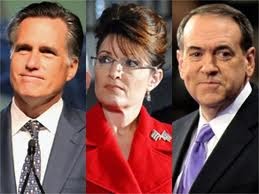 |
| Romney, Palin. and Huckabee |
Subscribe to:
Comments (Atom)